
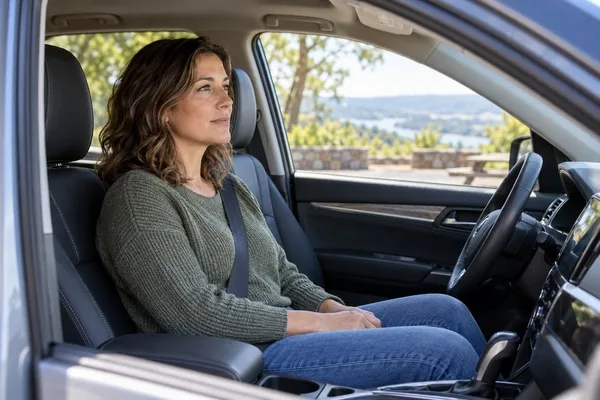
If your chest tightens every time you merge onto I-4, or you have started taking back roads just to avoid the interstate, you are not overreacting and you are not alone. Driving-related panic is a common form of anxiety, and anxiety counseling can give you practical tools so you are no longer just gripping the wheel and waiting for it to pass.
At Orlando Thrive Therapy, we work with people in Dr. Phillips who are dealing with exactly this. If you are ready to talk it through, reach out to our team or call (407) 592-8997.
What does panic while driving look like day to day?
It often starts small. Your hands sweat at the Sand Lake Road on-ramp. Your heart races when traffic stops suddenly near the theme park exits.
For some people, it builds into full panic attacks: a pounding heart, tightness in the chest, dizziness, tingling hands, and a strong urge to get off the road right now. Others never have a full attack, but they dread every drive and feel wiped out once they arrive.
Driving around Dr. Phillips adds its own pressure. Tourist traffic heading to the parks, sudden lane changes near interchanges, and long backups toward downtown can all set off that feeling of being trapped with no exit.
One note before anything else. If chest pain or a racing heart is new for you, see your doctor first to rule out a medical cause. If the doctor finds nothing physical and the symptoms keep coming back behind the wheel, anxiety is a likely part of the picture.
Why does driving anxiety spread into the rest of your life?
Because avoidance works in the short term and backfires over time. Each time you skip the interstate and feel relief, your brain learns that the highway really was dangerous. The fear grows, and the list of places you will drive gets shorter.
In Orlando, that shrinking list gets expensive fast. Skipping I-4 can mean crawling along Kirkman Road or Turkey Lake Road instead, turning down plans across town, or asking someone else to drive.
One of our clients knew it was time to get help when simple errands, like grocery shopping, started to require complex planning to avoid every highway. He was too afraid to get on them. Some of those trips took him an extra hour of driving.
That is a lot of time and energy spent managing fear. Many people also notice the anxiety creeping into other areas: trouble sleeping before a long drive, tension at work, or a growing worry about panic in other places, like crowded stores.
How does anxiety counseling help with panic attacks while driving?
Anxiety counseling teaches you specific skills to use before, during, and after a drive, so you are not left white-knuckling each episode on your own. The goal is to make the fear smaller and more manageable over time, not just easier to endure.
Cognitive behavioral therapy (CBT) is one of the most effective approaches for anxiety. It helps you notice the thoughts that fuel panic, like "I'm going to lose control" or "I can't get off this road," and replace them with more accurate ones.
Your therapist may also teach you breathing routines and mindfulness exercises you can use at a red light or in a parking lot before you pull out. These calm your body down, so a racing heart does not snowball into a full attack.
From there, you and your therapist build a step-by-step plan to return to the roads you have been avoiding, at a pace you agree on together. You can read more about how we approach anxiety therapy in Orlando.
What happens in your first anxiety counseling session?
Your first session is a conversation, not a test. It includes a detailed evaluation of where your anxiety comes from, how it affects your daily life, and what you have already tried that did not help.
For driving panic, that usually means talking through specific drives. Which roads feel hardest? Is it the speed, the merging, being far from an exit, or being stuck in traffic? Does the fear show up as a passenger too? These details shape the plan.
By the end, you and your therapist start building an action plan together. You can fill out intake forms online ahead of time, so the session itself stays focused on you.
Our founder, Heather Oller, LMHC, has more than 23 years of experience, and our team includes licensed counselors with advanced training in anxiety disorders. There is no waitlist, so you do not have to wait months to get started.
Are in-person sessions available in Dr. Phillips?
Yes. We see clients in person at our Dr. Phillips office on Wallace Road, close to Sand Lake Road and Dr. Phillips Boulevard. For many people, it is a short drive on familiar local streets, with no interstate required.
That matters when driving is the very thing you are working on. Getting to your appointment should not be another source of dread. If even a short drive feels like too much right now, teletherapy is available anywhere in Florida, so you can start from home and move to in-person sessions when you are ready.
You do not have to keep planning your life around which roads you can handle. Our phone line is open from 8am to 8pm.
When you are ready to take the first step, contact Orlando Thrive Therapy or call (407) 592-8997 to book anxiety counseling with a therapist who understands driving-related panic.