
Men's Therapy in Orlando: What It Looks Like When You Finally Go
A lot of men spend years thinking about therapy before they ever pick up the phone. You turn the idea over on the commute home, you tell yourself things are not that bad, and then another stressful week stacks on top of the last one. If that sounds familiar, you are not alone, and you are not behind. At Orlando Thrive Therapy, we work with men every week who waited a long time to walk through the door and then wished they had come sooner. This is a look at what actually happens when you go, written plainly so the unknown feels a little smaller.
Why Men Actually Come In
The reasons men reach out are rarely dramatic. More often they are quiet and persistent. Career pressure is near the top of the list. The job demands more than it used to, the inbox never empties, and the line between work and home keeps blurring until there is no real off switch. That kind of chronic stress wears on your body and your patience long before you call it burnout.
Anger shows up a lot too, though it is usually a messenger rather than the real problem. When a man finds himself snapping at his kids over nothing or simmering in traffic on Interstate 4, there is almost always something underneath it that has not had room to breathe. Relationship strain is another common starting point. Maybe communication with your partner has turned into the same argument on repeat, or maybe you have just drifted into living like roommates and you can feel the distance.
And then there is the one men name least but feel most: numbness. Not sadness exactly, more like the color has drained out of things you used to enjoy. You go through the motions, you handle your responsibilities, and you quietly wonder where the spark went. Feeling stuck, flat, or strangely empty is one of the most common reasons men finally decide to talk to someone, and it is a completely valid one.
What a Session Actually Looks Like
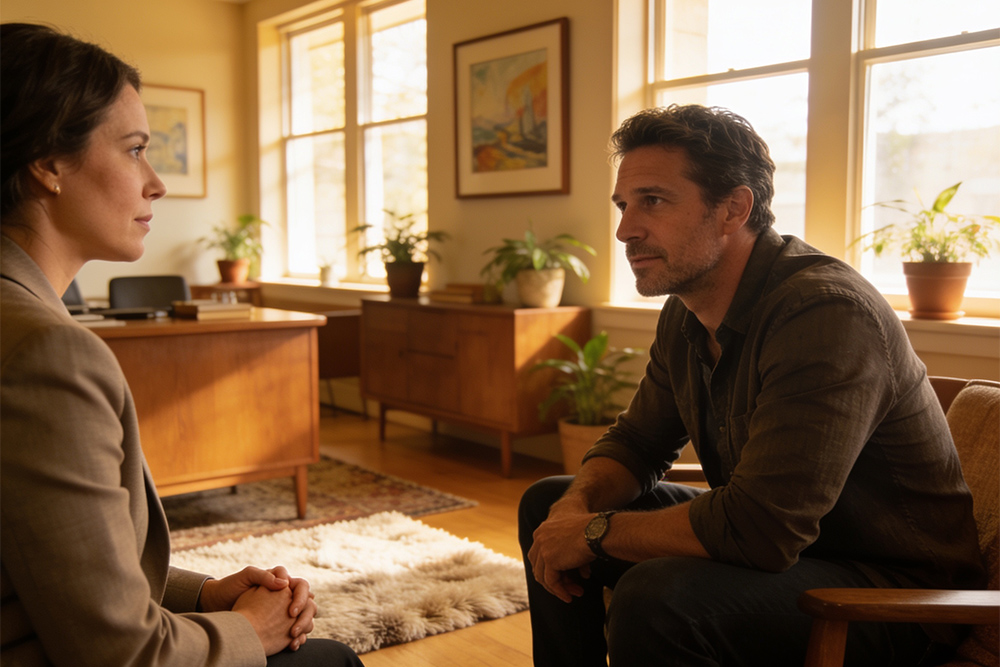
Forget the version you have seen on television. There is no couch you are forced to lie on, no one psychoanalyzing your childhood while you stare at the ceiling, and no expectation that you arrive ready to cry. A session is a conversation in a private, comfortable room with a person whose entire job is to be on your side.
The first session is mostly about getting oriented. Your therapist asks direct questions about what is going on in your daily life, what brought you in, and what you want to be different. You do not have to have it all figured out or explain yourself perfectly. You talk, the therapist listens closely, and together you start naming the things that have been hard to put into words. Many men are surprised by how normal it feels, more like a focused conversation with someone sharp and trustworthy than anything clinical.
From there, sessions tend to follow your lead. Some weeks you come in with a specific situation to work through, like a conflict at work or a hard talk you need to have at home. Other weeks you dig into a pattern that keeps repeating. Our individual therapy is built around what is genuinely useful to you, not a rigid script, and you can expect to leave most sessions with something concrete to think about or try.
What You Will Not Find
You will not be judged. You will not be told to just think positive. And you will not be handed a diagnosis you did not ask for. Because Orlando Thrive Therapy runs on a private pay model, your sessions stay genuinely confidential and your care is shaped by your needs rather than by what an insurance company will approve. That privacy matters to a lot of the men we see, especially those in careers where they would rather their personal life stay personal.
Asking for Help Is a Strength, Not a Weakness
Somewhere along the way, a lot of men absorbed the idea that handling everything alone is what makes you strong. It is worth questioning that. The strongest people you know almost certainly have help, whether it is a coach, a mentor, a trainer, or a mind they trust to think things through with. Going to therapy is the same instinct applied to the part of your life that runs everything else.
It takes real nerve to look at what is not working and decide to face it directly. Avoidance is the easy path. Booking the appointment, showing up, and saying the hard thing out loud is the harder, braver one. Reaching out is not raising a white flag. It is taking ownership of your stress, your relationships, and your future instead of hoping they sort themselves out. The men who get the most from therapy are usually the ones who reframed asking for help as something they did on purpose, not something that happened to them.
The Practical, Goal Focused Approach Men Tend to Appreciate
Many men prefer to fix things rather than talk in circles about them, and good therapy respects that. Our approach with men leans practical and goal driven. Early on, you and your therapist define what you actually want, whether that is handling stress without it leaking onto your family, communicating with your partner without it turning into a fight, or simply feeling like yourself again. Those goals become the compass for the work.
The methods behind it are evidence based, which means they have been studied and shown to help rather than just sounding nice. Cognitive Behavioral Therapy gives you tools to interrupt the thought patterns that fuel stress and anger. Acceptance and Commitment Therapy helps you stop wrestling with every difficult feeling and start acting on what matters to you. For deeper wounds, including unresolved trauma that quietly drives anger or numbness, EMDR therapy helps your brain reprocess painful memories so they stop running the show.
When stress has curdled into something heavier, our anxiety therapy gives you concrete ways to settle a racing mind and get your footing back. And when the strain is mostly in your relationship, working through it together in couples therapy can shift patterns that have been stuck for years. None of this is about endless processing for its own sake. It is about giving you usable strategies and a clear direction so you can thrive, not just survive.
Getting Matched and Getting Started
One thing that trips men up is the fear of getting stuck with a therapist they do not click with. We take that seriously. Our in house admin team learns a bit about you and your goals first, then matches you with a clinician who actually fits, so you are not rolling the dice. The right fit makes an enormous difference, and it is worth getting right from the start.
Practical details tend to be smoother than men expect. There are no wait lists, intake paperwork is handled electronically before you arrive, and we offer flexible daytime and evening hours across our Downtown Orlando, Winter Park, Dr. Phillips, and Altamonte Springs offices, plus secure teletherapy if you would rather meet from home. Our team responds within twenty four hours, and a free consultation is available so you can get a feel for things before committing to anything. You can read more about men's therapy and how we tailor it to the way you process problems.
Take the First Step
The hardest part of therapy is almost always the decision to start, and you have already done the work of reading this far. When you are ready, reach out to our team to schedule a free consultation and get matched with someone who fits. You do not have to have the right words ready or know exactly what is wrong. You just have to take the first step, and we will help you with the rest.
Start Your Journey Toward Thriving
Connect with a compassionate Orlando therapist and take the first step toward healing, clarity, and lasting emotional well-being.