
EMDR Therapy for PTSD in Florida: Does It Really Work?
PTSD doesn't just affect the person living with it. It affects the people closest to them too. If you or your partner are struggling with flashbacks, emotional withdrawal, or constant anxiety, Orlando Thrive Therapy is here to help. Call us at (407) 592-8997 to talk through your options today.
Couples across Central Florida, from the quiet neighborhoods near Cranes Roost Park in Altamonte Springs to the busy streets of Winter Park, are dealing with the ripple effects of PTSD every day. One partner wakes up at 3 a.m. gripped by a flashback. The other doesn't know how to help. Communication shuts down. Distance grows. What started as one person's trauma slowly becomes a shared burden.
The good news? There's a therapy approach that has strong research behind it, and it's helping people heal faster than traditional talk therapy alone. It's called EMDR, and this post breaks down exactly how it works, what it does to the brain, and how to find the right provider here in Florida.
What Is EMDR Therapy, and How Does It Work?
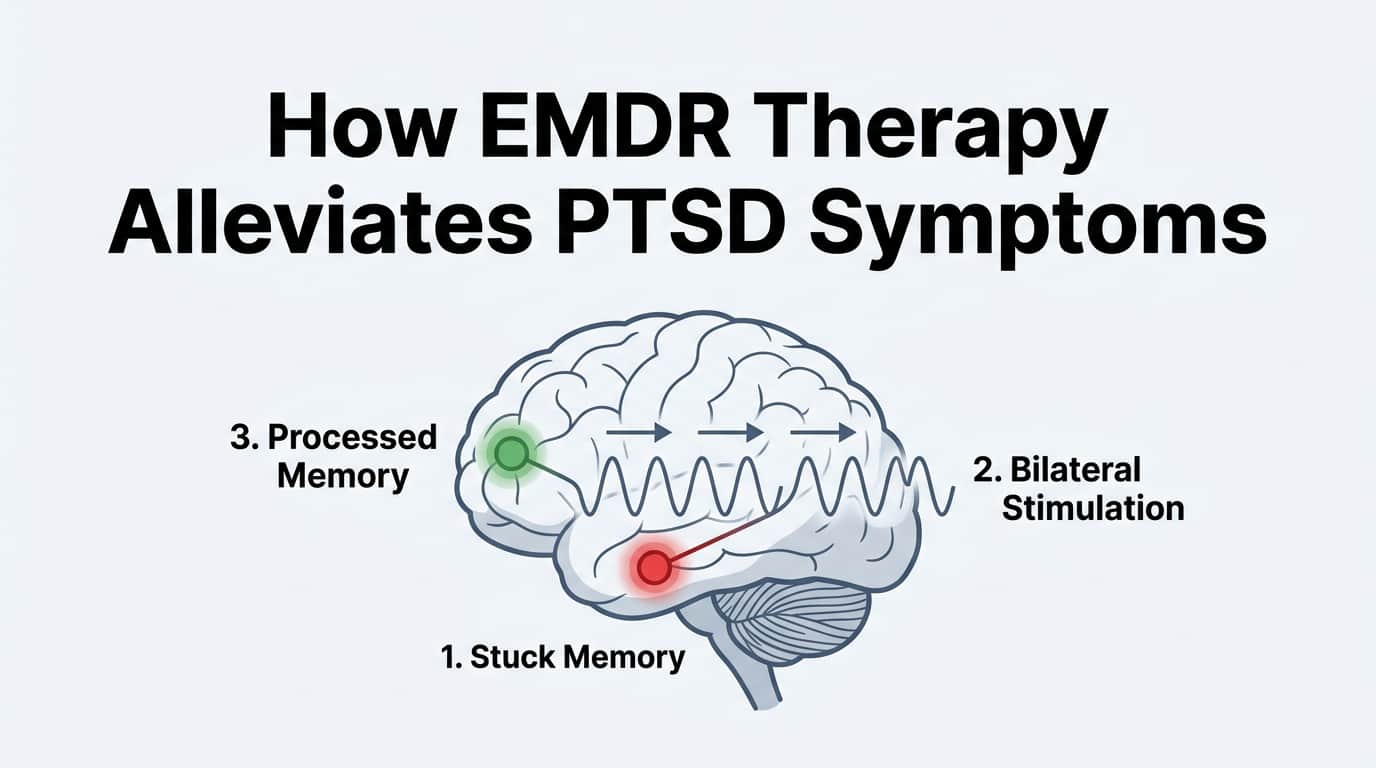
EMDR (Eye Movement Desensitization and Reprocessing) is an evidence-based treatment that helps the brain reprocess traumatic memories so they no longer trigger intense physiological and emotional responses. Rather than talking through the trauma at length, EMDR uses bilateral stimulation, typically guided eye movements, while you briefly focus on a distressing memory. This process allows the brain to refile that memory in a way that reduces its emotional charge.
Think of it like a filing cabinet that got jammed during a crisis. The memory is still in there, but it's stuck in the wrong drawer, causing disruption every time your brain tries to function normally. EMDR helps move it to the right place so it stops interfering with daily life.
Sessions typically run 60 to 90 minutes. Most people complete a full course of treatment in 6 to 12 sessions, though complex trauma may require more. That's significantly faster than many traditional therapy models, which can span years.
If you'd like to learn more about what EMDR looks like in practice, visit the EMDR therapy page at Orlando Thrive Therapy for a full breakdown of the approach and who it's designed to help.
How Does PTSD Actually Affect Daily Life in Florida?
PTSD symptoms range from disruptive to debilitating, and they rarely stay confined to the individual experiencing them. Partners, families, and relationships absorb the impact.
Common symptoms include:
- Flashbacks and intrusive memories: Sudden, vivid re-experiencing of a traumatic event, often triggered by sights, sounds, or smells
- Hypervigilance: A constant state of alertness that makes relaxation feel impossible
- Avoidance: Steering clear of people, places, or conversations that might trigger memories
- Emotional numbness: Difficulty feeling joy, connection, or closeness with a partner
- Sleep disruption: Nightmares and insomnia that leave both partners exhausted
Florida's environment can add layers of complexity. For veterans and first responders living near areas like the Florida National Guard facilities in Orlando, noise and sudden stimuli are everyday realities that can activate PTSD symptoms without warning. Even attending a crowded event near the Altamonte Mall can feel overwhelming for someone in a hypervigilant state.
These aren't character flaws. They're the brain's protective responses stuck in the "on" position long after the original threat has passed.
What Does EMDR Actually Do to the Brain?
EMDR works by targeting how traumatic memories are stored. Under normal circumstances, the brain processes experiences during sleep, gradually integrating them into long-term memory and reducing their emotional intensity over time. Trauma disrupts that process. The memory gets stored in a raw, unprocessed state, complete with the original emotions, physical sensations, and distorted beliefs attached to it.
When something in the present resembles the original trauma, even slightly, the brain responds as if the danger is happening again. That's why a car backfiring can send a veteran to the floor, or why a raised voice can shut a person down completely.
EMDR's bilateral stimulation appears to activate the brain's natural processing system, similar to what happens during REM sleep. Research published by the American Psychological Association confirms EMDR as an effective treatment for PTSD, with studies showing symptom reduction in approximately 77% to 90% of single-trauma cases after just three 90-minute sessions.
The therapy also targets the negative core beliefs that form around trauma. Beliefs like "I'm not safe," "I'm to blame," or "I'm not worthy of love" get reprocessed alongside the memories, which creates lasting change at a much deeper level than symptom management alone.
How Does EMDR Reduce Flashbacks, Anxiety, and Hypervigilance?
EMDR directly addresses the three most disruptive PTSD symptom clusters: re-experiencing, avoidance, and hyperarousal.
Flashbacks lose their grip because the memory itself gets reprocessed. Once the brain files it correctly, the memory no longer carries the same emotional weight. A client who couldn't think about a car accident without shaking can eventually recall it as something that happened, rather than something that's still happening.
Anxiety decreases because the triggers that fed it get neutralized. When the underlying memory no longer fires a threat response, everyday situations stop feeling dangerous. Couples often notice this shift first in social settings, where one partner becomes visibly calmer and more present.
Hypervigilance fades as the nervous system recalibrates. The body stops producing a constant flood of stress hormones when it no longer perceives a threat around every corner. Sleep improves. Irritability decreases. Partners report that conversations feel easier and less likely to escalate.
For couples seeking support alongside individual trauma work, relationship counseling and teletherapy services are also available through Orlando Thrive Therapy, allowing both partners to access care on their own terms.
Does EMDR Help Couples Dealing With One Partner's PTSD?
Yes, and this is where EMDR therapy Altamonte Springs Florida residents have been seeking becomes especially relevant for couples. When one partner carries unprocessed trauma, it creates patterns that affect both people. Emotional unavailability, conflict avoidance, sudden anger, and loss of intimacy are all common side effects of untreated PTSD within a relationship.
EMDR doesn't work on the relationship directly. It works on the individual. But healing one person's trauma has a consistent ripple effect on the partnership. As the individual's symptoms reduce, they become more emotionally available, less reactive, and more capable of genuine connection.
Many couples find that combining individual EMDR therapy with couples therapy Altamonte Springs Florida provides the most complete path forward. Individual EMDR addresses the root of the trauma while couples therapy builds the communication tools and emotional safety needed to reconnect.
Our therapists at Orlando Thrive Therapy have seen this combination produce results that neither approach achieves alone. One partner processes and heals. The other learns to understand what their partner has been carrying. Together, they build something stronger.
How Do You Find a Qualified EMDR Therapist in Florida?
Not every therapist who lists EMDR on their website is fully trained. Proper EMDR training follows a structured certification process through EMDRIA (the EMDR International Association), which includes supervised practice hours and ongoing consultation.
When searching for a provider, look for:
- EMDRIA-certified or EMDRIA-approved training: This confirms the therapist has completed the full training protocol, not just an introductory workshop
- Experience with trauma populations: Ask how many PTSD clients they've treated with EMDR specifically
- Clear intake process: A good EMDR therapist will conduct a thorough history before beginning active reprocessing, usually over 2 to 3 sessions
- Location and accessibility: For residents near Cranes Roost Park or anywhere in Seminole County, the Altamonte Springs office at 940 Centre Circle, Suite 1012 offers convenient in-person access. Virtual sessions are also available throughout Florida and New York via teletherapy services
Session costs for EMDR therapy in Florida typically range from $150 to $250 per session at private-pay practices. Orlando Thrive Therapy operates as a private-pay practice, meaning they're not limited by insurance restrictions on treatment methods or session frequency. That matters when you're doing trauma work that requires consistency and flexibility.
Ready to Start Healing? Here's Your Next Step.
PTSD is treatable. The brain can reprocess what trauma left behind. For couples in the Altamonte Springs, Winter Park, and greater Orlando area, real support is available right now.
Orlando Thrive Therapy offers EMDR therapy, couples therapy Altamonte Springs Florida, and teletherapy services for residents across Florida and New York. Their team has over three decades of combined experience helping individuals and couples rebuild connection, reduce trauma symptoms, and move forward with confidence.
Call (407) 592-8997 today. You don't have to keep managing this alone.
Start Your Journey Toward Thriving
Connect with a compassionate Orlando therapist and take the first step toward healing, clarity, and lasting emotional well-being.